

If you own waterfront property in South Florida, you have probably wondered whether a dock repair counts as a construction project in the eyes of the state. The short answer is: it depends on the scope of work, but in most cases, yes, a permit is required.
Florida’s waterways are regulated by multiple agencies, and the line between a minor repair and a permitted replacement is not always obvious. Getting this wrong can result in stop-work orders, fines, and forced removal of completed work.
When Dock Repairs Require a Permit in Florida
Not every repair triggers a permit requirement, but the threshold is lower than most homeowners expect. Understanding Florida marine construction permit requirements before starting protects you from stop-work orders, fines, and forced removal of completed work. Florida agencies draw a clear distinction between routine maintenance and work that alters the structure.
Like-for-Like Board Replacement
Replacing individual decking boards with the same material and dimensions is generally considered routine maintenance. No permit is typically required for this type of work in most Florida counties, provided the structural framing is not modified.
Piling Replacement
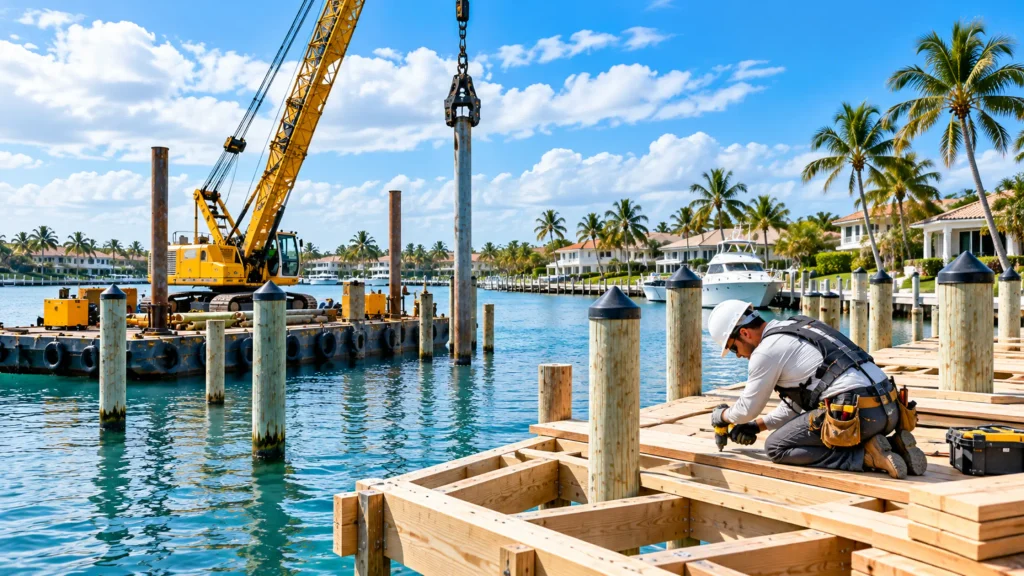
Replacing a damaged or deteriorated piling almost always requires a permit, even if you are matching the original size and location. Piling work disturbs the submerged bottom, which triggers review under the Florida Department of Environmental Protection Environmental Resource Permit program.
Structural Repairs to Framing
Repairing or replacing stringers, cross-bracing, or framing members is considered structural work. A building permit from your local municipality is required in addition to any state or federal environmental permits.
Adding Electricity or Water
Any addition of electrical wiring, lighting, or water supply to an existing dock requires a local building permit and electrical inspection. This applies even if the dock structure itself is not being modified.
When Full Dock Replacement Requires a Permit in Florida
A full dock replacement is treated as new construction under Florida law. This means the project is subject to the same permitting requirements as building a dock from scratch.
| Permit Type | Issuing Agency | Typical Timeline |
| Local Building Permit | County or Municipal Building Dept | 2 to 6 weeks |
| Environmental Resource Permit (ERP) | Florida DEP | 60 to 90 days |
| Section 404 / Nationwide Permit | U.S. Army Corps of Engineers | 30 to 45 days |
| Submerged Land Authorization | Florida DEP (Board of Trustees) | Concurrent with ERP |
Environmental Resource Permit (ERP)
The Florida DEP requires an Environmental Resource Permit for any structure built over, in, or adjacent to state waters. A full dock replacement triggers this requirement regardless of whether the footprint is changing.
U.S. Army Corps of Engineers Section 404
The Army Corps of Engineers has jurisdiction over navigable waterways. Dock replacements in tidal waters, canals connected to navigable rivers, and coastal areas typically require a Section 404 permit or a Nationwide Permit depending on the project scope.
Local County and Municipal Permits
Palm Beach, Broward, and Miami-Dade counties each have their own building departments with dock-specific permit requirements. Local permits run concurrently with state and federal applications but must be obtained separately.
Submerged Land Authorization
Florida’s submerged land is owned by the state. If your dock sits over sovereign submerged lands, you need a Submerged Land Lease or Easement from the Board of Trustees of the Internal Improvement Trust Fund, administered through the Florida DEP.
Factors That Affect the Permitting Path for Your Dock
The specific permits required depend on several site-specific factors. Two dock projects that look identical on paper can have completely different permitting requirements based on location and conditions.
Water Body Type
Docks on tidal waters, navigable rivers, and coastal canals involve both state and federal jurisdiction. Freshwater lake and pond docks in non-navigable waters may only require local permits, significantly simplifying the process.
Dock Size and Footprint
Projects that increase the square footage of the dock beyond the original structure are subject to more rigorous review. Staying within the existing footprint is one of the most effective ways to reduce permitting complexity on a replacement project.
Proximity to Seagrass and Coral
South Florida’s waterways support protected seagrass beds and coral habitats. Any dock replacement within proximity to these resources triggers additional environmental review and may require mitigation. A pre-application site survey is strongly recommended before submitting any permit applications in these areas.
Hurricane Damage Repairs
Docks damaged by hurricanes or tropical storms may qualify for expedited permitting under Florida’s disaster relief provisions. The scope of damage must be documented, and the replacement must conform to current code. B&Z Construction’s marine construction services in South Florida include storm damage assessment and permit coordination for hurricane-affected dock structures.
How Long Does the Dock Permit Process Take in Florida?
Permit timelines vary significantly depending on the agencies involved and the complexity of the project. Planning ahead is essential.
Local Building Permits
Most county and municipal building permits for dock work are issued within 2 to 6 weeks of a complete application submission. Incomplete applications are the most common cause of delays at this stage.
Florida DEP Environmental Resource Permit
Standard ERP review takes 60 to 90 days for straightforward projects. Projects near protected resources or requiring public notice can extend the review period to 6 months or longer.
Army Corps of Engineers Nationwide Permit
Nationwide Permits are pre-authorized permits for activities with minimal environmental impact. They are typically verified within 30 to 45 days, making them significantly faster than an Individual Permit, which can take 12 months or more.
Total Timeline for a Full Replacement
A realistic timeline for a fully permitted dock replacement in South Florida runs 3 to 6 months from initial application to permit issuance, assuming no significant environmental issues and complete documentation at submission.
What Happens if You Replace a Dock Without a Permit in Florida?
Skipping the permit process carries serious consequences that can exceed the cost of the project itself.
Stop-Work Orders
Florida DEP inspectors and local code enforcement officers patrol waterways. An unpermitted dock can be issued a stop-work order at any point during construction, halting the project until permits are obtained.
Fines and Penalties
Unpermitted marine construction in Florida can result in fines from multiple agencies simultaneously. DEP fines, Army Corps penalties, and local code violations can stack up quickly. Penalties often exceed $10,000 for significant violations.
Forced Removal
In cases where the structure is deemed non-compliant or causes environmental damage, regulators can require removal at the owner’s expense. This means paying twice: once to build and once to remove. Working with an experienced marine construction contractor from the start is the most reliable way to avoid this outcome.
Conclusion
Dock repair and replacement permitting in Florida involves multiple agencies, and the requirements vary based on your location, water body type, and the scope of work. The safest approach is to confirm permit requirements before any work begins, not after.
B&Z Construction handles permit coordination, site surveys, and the full construction process for dock replacement projects across Palm Beach, Broward, and Miami-Dade counties.
Frequently Asked Questions
Does replacing dock boards require a permit in Florida?
Replacing individual decking boards with identical materials on an otherwise intact structure is typically considered maintenance and does not require a permit. Any modification to pilings, framing, or overall dimensions changes that classification and likely triggers a permit requirement.
Can I replace my dock without a contractor in Florida?
Homeowners can pull owner-builder permits for dock work in Florida, but the permitting process still applies. The complexity of coordinating DEP, Army Corps, and local applications makes working with an experienced marine construction contractor the practical choice for most replacement projects.
How much does a dock permit cost in Florida?
Permit fees vary by agency and project scope. Local building permit fees typically run $500 to $2,000. DEP Environmental Resource Permit fees depend on project type. Army Corps fees for Nationwide Permits are generally low, but third-party survey and engineering costs can add $2,000 to $5,000 to the total.
Do I need a permit to add a boat lift to an existing dock in Florida?
Yes. Adding a boat lift to an existing dock structure is treated as new construction and requires both local building permits and, in most cases, a state environmental permit. The lift’s footprint and its potential impact on navigation and habitat are reviewed as part of the application.
What is the difference between a Nationwide Permit and an Individual Permit from the Army Corps?
A Nationwide Permit covers activities the Army Corps has pre-determined to have minimal environmental impact, including many standard dock replacements. An Individual Permit is required for larger or more complex projects with greater potential impacts and involves a full public review process. Canal and lake dredging often requires an Individual Permit due to the volume of material disturbed.